
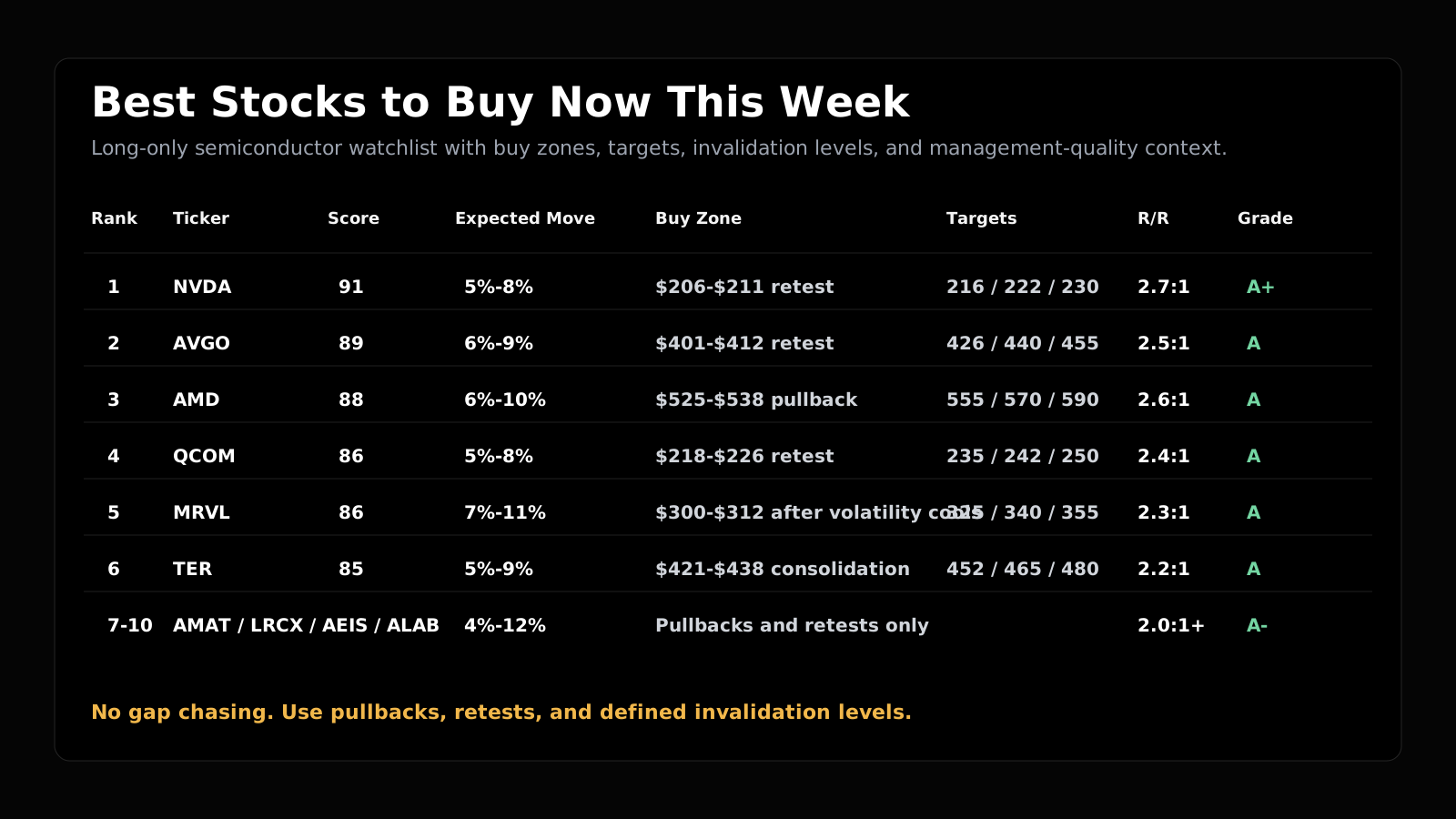
This week’s best stocks to buy now list is a long-only research watchlist. The goal is to identify strong candidates with defined entry areas, target zones, and invalidation levels before capital is committed.
The strongest theme right now is AI and semiconductor leadership. That does not mean every chip stock should be chased. The cleanest setups are pullbacks, breakout retests, or 1-hour and 4-hour consolidations after strength. The list below keeps the same ranking data from the weekly screen and links each ticker to the company’s official investor page in a new window.
Weekly ranking table
| Rank | Ticker | Score | Expected Move | Expectancy Score | Buy Zone | Stop / Invalidation | T1 | T2 | T3 | R/R | Grade |
|---|---|---|---|---|---|---|---|---|---|---|---|
| 1 | NVDA | 91 | 5%-8% | 7.2 | $206-$211 retest / hold above 20-50DMA area | Below $203 or failed SMH support | $216 | $222 | $230 | 2.7:1 | A+ |
| 2 | AVGO | 89 | 6%-9% | 6.9 | $401-$412, preferably retest not chase | Below $397 or failed 50DMA reclaim | $426 | $440 | $455 | 2.5:1 | A |
| 3 | AMD | 88 | 6%-10% | 6.8 | $525-$538 pullback / 1-hour reset | Below $517 | $555 | $570 | $590 | 2.6:1 | A |
| 4 | QCOM | 86 | 5%-8% | 6.2 | $218-$226 retest after 6% surge | Below $213 | $235 | $242 | $250 | 2.4:1 | A |
| 5 | MRVL | 86 | 7%-11% | 6.1 | $300-$312; only after volatility cools | Below $292 | $325 | $340 | $355 | 2.3:1 | A |
| 6 | TER | 85 | 5%-9% | 5.8 | $421-$438 retest / tight consolidation | Below $414 | $452 | $465 | $480 | 2.2:1 | A |
| 7 | AMAT | 84 | 4%-7% | 5.2 | $612-$622 support retest | Below $600 | $638 | $655 | $675 | 2.1:1 | A- |
| 8 | LRCX | 83 | 4%-7% | 5.0 | $387-$396 retest | Below $379 | $405 | $418 | $430 | 2.1:1 | A- |
| 9 | AEIS | 82 | 5%-8% | 4.8 | $358-$373, no chase above $375 | Below $350 | $386 | $397 | $410 | 2.0:1 | A- |
| 10 | ALAB | 81 | 7%-12% | 4.5 | Only on pullback to $384-$405 | Below $372 | $430 | $450 | $475 | 2.0:1 | A- / high risk |
Best risk-adjusted focus
The cleanest focus list is NVDA, AVGO, AMD, and QCOM. Those four names offer the best mix of liquidity, theme alignment, relative strength, and defined risk zones. MRVL and TER can work, but they need smaller sizing and cleaner intraday consolidation because the volatility is higher.
The management-quality question is simple: which companies can keep translating AI demand into execution, margin durability, product leadership, and credible capital allocation after the easy narrative is already priced in?
NVDA: Best balance of liquidity, sector alignment, and controlled risk
NVDA is the top-ranked candidate because it gives the best blend of liquidity, AI leadership, semiconductor strength, and manageable entry structure. The stock closed near $210.69, up about 2.85%, with very high volume. Its 20-day and 50-day moving-average area was roughly $211.79 and $209.31, which puts the setup near a logical retest zone rather than a pure chase.
The clean entry is not a gap-up buy. NVDA is strongest as a watchlist candidate if SMH holds strength and the stock holds the $206-$211 zone. A failure below $203 or failed SMH support weakens the setup. For deeper diligence, start with NVIDIA’s investor page and focus on data-center growth, gross margin durability, and leadership’s capacity planning commentary.
AVGO: Strong rebound, but not as clean as NVDA
AVGO closed at $411.35, up 4.7%, with volume around 43.9 million shares, well above its 50-day average of about 26 million. That volume acceleration is constructive because it shows real participation behind the move.
The issue is entry quality. AVGO is still below its recent 52-week high, and the better setup is a controlled pullback or breakout retest instead of chasing strength. The key zone is $401-$412, with a risk line around $397 if it loses the 50-day moving-average reclaim. The management-quality lens is capital allocation: Broadcom’s acquisition discipline, AI infrastructure exposure, and margin integration work matter as much as the chart.
AMD: High upside with higher valuation and volatility risk
AMD closed around $537.37, up about 4.7%. Its 50-day moving average was cited near $508.85 and the 200-day near $481.88, so the larger trend structure is still favorable.
The tradeoff is extension. AMD already sits above key moving averages, which raises chase risk. The cleaner setup is a pullback, flag, or 1-hour reset into the $525-$538 area. A gap-up without consolidation is lower quality for capital protection. Investors should pair the technical setup with AMD’s official investor materials on AI accelerator traction, roadmap execution, and data-center share gains.
QCOM: Strong short-term relative strength and volume surge
QCOM rose about 6.17% to $226.11, with volume around 45.9 million shares, more than double its 50-day average of 22.6 million. That type of volume surge can point to accumulation, especially when it happens inside a stronger sector tape.
The one-day move also creates chase risk. The better plan is to watch the $218-$226 area and see whether it holds as support. QCOM is best treated as a retest trade, with $213 as the invalidation level from this screen. The operating question is diversification: handset durability, automotive growth, edge AI, and management’s ability to expand beyond the historical mobile-cycle narrative.
MRVL and TER: Higher-beta momentum trades
MRVL and TER both sit in the higher-beta portion of the list. MRVL posted a strong latest-session gain with unusually high volume, while TER has an attractive consolidation zone in the $421-$438 range. Both require smaller sizing and cleaner intraday structure because the stops must be wider.
MRVL is more attractive after a 1-hour or 4-hour consolidation that tightens the stop. TER needs to hold $414 to keep the setup intact. Management quality matters here because higher-beta names punish weak execution faster: investors should look for clear backlog commentary, margin control, and credible demand signals in official updates.
AMAT and LRCX: Equipment exposure with cleaner retest areas
AMAT and LRCX bring semiconductor equipment exposure into the list. AMAT has a support retest zone around $612-$622, while LRCX has a $387-$396 retest zone. Both are less aggressive than the highest-beta momentum names but still depend on the broader chip tape holding together.
The management-quality lens is cycle discipline. Equipment names need strong leadership around backlog, customer concentration, capital intensity, and downturn preparation. The trade works best when the chart confirms strength and the business narrative supports durable demand.
AEIS and ALAB: Emerging opportunities with tighter discipline
AEIS passes as an emerging opportunity because it has AI and data-center exposure and recently regained a key level. It does not qualify as a core large-cap trade in the same way as NVDA or AVGO because institutional behavior was described as mixed to negative.
ALAB has strong momentum, but it is also one of the highest-risk names on the list after an 11%+ move. It only qualifies on a pullback into the $384-$405 area. Buying ALAB extended violates the capital-protection discipline behind this screen.
Names that did not make the actionable list
CRWV stays watchlist-only for this 5-14 day system. It has AI infrastructure exposure and liquidity, but negative EPS, elevated volatility, and weaker risk control keep it outside the actionable list.
Financials and healthcare are also lower priority for this specific swing screen because XLF and XLV underperformed SPY on the latest available data. Under this model, that violates the sector-strength requirement for fresh long ideas.
Execution rules for this week
The cleanest action is not to buy gaps. Use pullbacks, breakout retests, or 1-hour and 4-hour consolidations. Keep total AI and semiconductor theme concentration below 40% of capital assigned to this strategy.
Micron earnings on June 24 can move the entire chip tape, so position sizing should be reduced before that event or paired with tighter, pre-defined invalidation levels.
Final ranking: NVDA, AVGO, AMD, QCOM, MRVL, TER, AMAT, LRCX, AEIS, ALAB.
Trading is probabilistic. No setup guarantees profit, and position size should fit your own risk tolerance. This watchlist is for research and education, not personal financial advice.